
98% Dihydroxyacetone/1,3-Dihydroxyacetone
How much do you know about dihydroxyacetone?
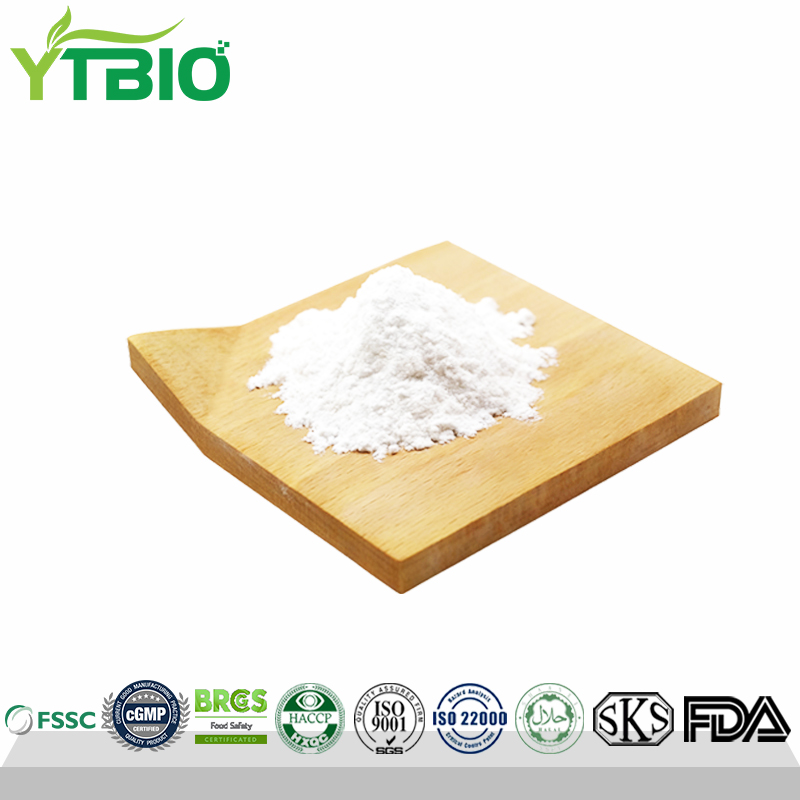
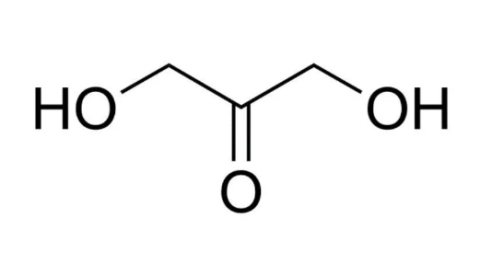
Dihydroxyacetone (DHA, 1,3-Dihydroxyacetone), with the molecular formula C₃H₆O₃, is the simplest ketose sugar. At room temperature, it is a white crystalline powder with a sweet taste, easily soluble in water and many organic solvents. As a naturally occurring intermediate in sugar metabolism in living organisms, it can be efficiently produced through microbial fermentation and possesses biodegradability and high safety for use. DHA is a versatile compound, with its core applications concentrated in two major fields: cosmetics and animal feed. In cosmetics, it is a key active ingredient in self-tanning products. It reacts with amino acids in the stratum corneum of the skin through the Maillard reaction, producing melanoidins, thus creating a natural tan appearance on the skin surface that lasts for several days, and also providing some moisturizing and auxiliary sun protection functions. In the feed industry, it is used as a feed additive to effectively regulate fat metabolism in animals (such as pigs), helping to reduce body fat and increase lean meat percentage. In addition, DHA can be used as an intermediate in the synthesis of certain drugs in the pharmaceutical field, and also shows potential applications in the food industry (as a potential functional additive), the leather industry (as a leather protective agent), and fruit and vegetable preservation. It is a fine chemical with practical value in multiple industries.
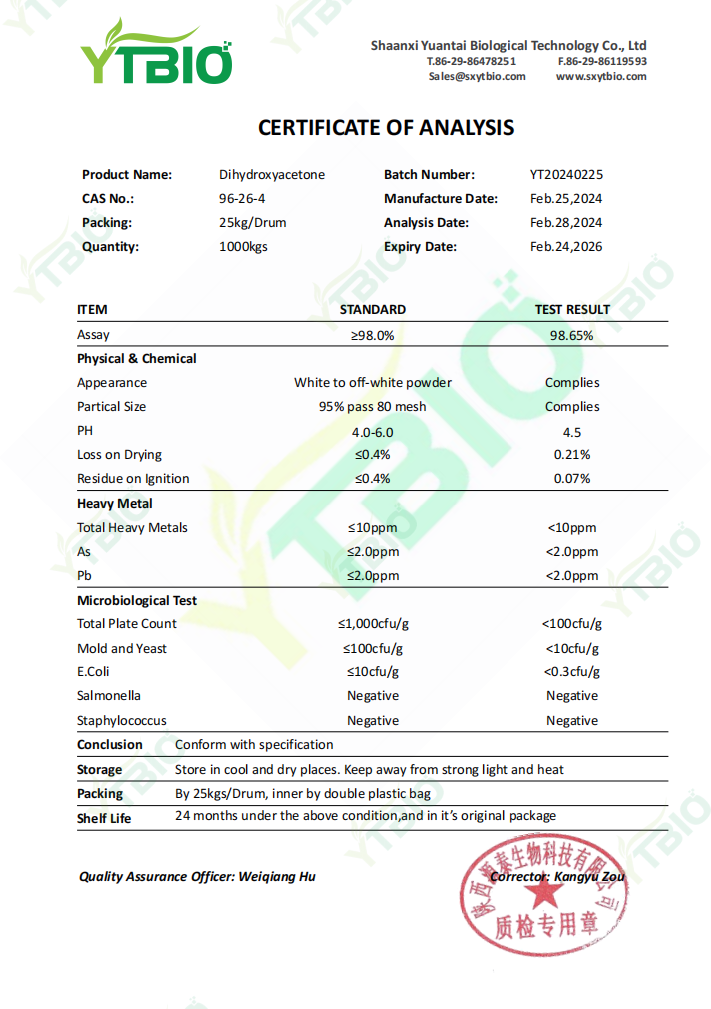
TSET REPORT OF DIHYDROXYACETONE
What are the main uses of dihydroxyacetone?
Cosmetics Industry (Core Application Area)
DHA is the core ingredient in sunless tanning products. Its mechanism of action is to react with free amino acids in the stratum corneum of the skin through the Maillard reaction, producing brownish melanin-like polymers, thus creating a natural, long-lasting tan effect on the skin surface, usually lasting 5-7 days. At the same time, the products formed by this reaction can form a protective film on the skin surface, providing auxiliary moisturizing, reducing water evaporation, and having a certain auxiliary effect in resisting ultraviolet radiation.
Feed Additive (Important Application Area)
As an intermediate product of sugar metabolism, DHA is used as a functional feed additive in animal nutrition. Studies have shown that it can effectively reduce body fat deposition in animals such as pigs by regulating carbohydrate and lipid metabolism, increasing lean meat percentage, thereby improving meat quality and economic value. Pharmaceuticals and Fine Chemicals
DHA is an important pharmaceutical intermediate and can be used to synthesize specific drugs for treating cardiovascular diseases and other conditions. Its reactive chemical properties also make it a valuable chemical raw material for the synthesis of various heterocyclic and chiral compounds.
Food Industry (Functional Applications)
As a functional food additive, DHA theoretically has the potential to regulate lipid metabolism, but its application in actual food products is still in the exploratory stage, and related product development is limited.
Other Applications
Due to its chemical properties, DHA can be used as a leather protective agent in the leather industry and also has potential as a natural preservative for fruits, vegetables, and aquatic products in the field of agricultural product preservation.
Common Synthesis Methods of Dihydroxyacetone
The synthesis of 1,3-dihydroxyacetone (DHA) mainly includes chemical synthesis and biological synthesis. Currently, the microbial-catalyzed glycerol method is mainly used in industry due to its higher selectivity and conversion efficiency.
1. Chemical Synthesis Methods
Chemical methods primarily involve the selective oxidation of glycerol or formaldehyde condensation.
Selective Oxidation of Glycerol
This method uses noble metal catalysts (such as Pt, Pt-Bi, Au-Pd/C, etc.) to catalyze glycerol, aiming to selectively oxidize the hydroxyl group on the secondary carbon of the glycerol molecule to a carbonyl group, thereby producing DHA. The challenge lies in simultaneously suppressing side reactions such as the oxidation of primary hydroxyl groups to produce glyceraldehyde, in order to improve the selectivity of the target product. Research reports show that under optimized catalyst and reaction conditions, the glycerol conversion rate can reach 100%, and the DHA yield can reach up to approximately 50%.

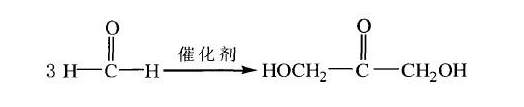
Formaldehyde Condensation Method
This method uses formaldehyde or paraformaldehyde as raw materials, and in a catalytic system composed of nitrogen-containing heterocyclic compound salts (such as thiazolium salts) and proton acceptors (such as amines), DHA is produced through formaldehyde self-condensation reaction. This pathway can achieve high selectivity; in some pilot studies, DHA selectivity can reach 93%-97%. However, the formaldehyde conversion rate is usually low (e.g., around 30%), and it has certain requirements for the reaction medium and separation and purification processes.
2. Biological Synthesis Method (Mainstream Industrial Method)
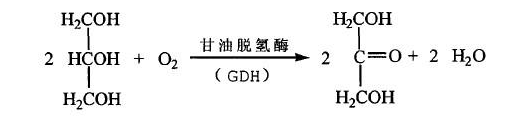
The biological method mainly utilizes glycerol dehydrogenase from specific microorganisms to efficiently and selectively catalyze the conversion of glycerol substrate into DHA.
Core Mechanism: Glycerol dehydrogenase in microorganisms (such as *Gluconobacter* and *Acetobacter*) specifically acts on the hydroxyl group of the secondary carbon of the glycerol molecule, causing dehydrogenation to produce DHA, with few byproducts and extremely high selectivity.
Process Advantages: Compared with chemical methods, biological methods are usually carried out at room temperature and pressure, under neutral pH conditions, resulting in lower energy consumption and avoiding the use of noble metal catalysts. Through strain selection and fermentation process optimization, high substrate conversion rates and high product yields can be achieved, making it currently the most cost-effective and environmentally friendly large-scale production process.
Although chemical methods have seen continuous improvements in catalyst design and reaction engineering, the microbial catalytic glycerol method, with its high selectivity, mild conditions, and overall advantages in terms of green economics, has become the mainstream technological route for the industrial production of 1,3-dihydroxyacetone.
References
[1] Ma Lijuan. Research on the biological production of 1,3-dihydroxyacetone [D]. Tianjin University, 2009, 3-4.
[2] Yu Jianer. Research on the indirect oxidation of glycerol to prepare 1,3-dihydroxyacetone [D]. Zhejiang University of Technology, 2009. 6-8.
[3] Pang Shenglan. Research on the synthesis of 1,3-dihydroxyacetone [D]. Shandong Normal University, 2012, 2-4.
[4] Ruan Lijuan. Biocatalytic production of 1,3-dihydroxyacetone from glycerol using resting cells [D]. Zhejiang University of Technology, 2012, 2-5.
