
Factory Supply 98% Phloretin Powder
What is phloretin?
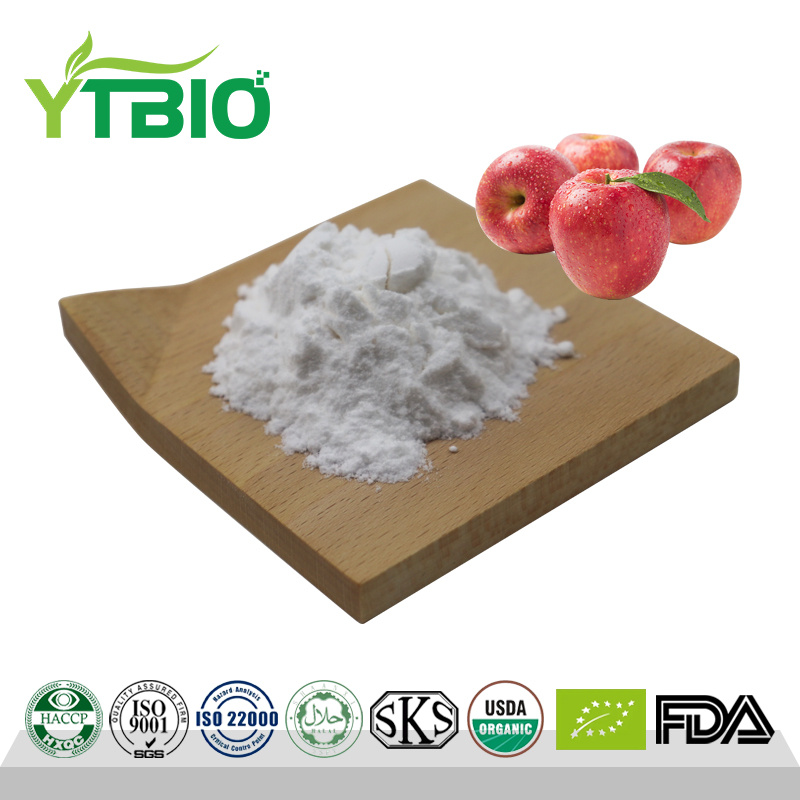
Phloretin, a naturally occurring flavonoid compound derived from apples, pears, and vegetable juices, is named after its primary presence in the root bark of fruit trees. Also known by its chemical name, trihydroxyphenol acetophenone, phloretin has been studied for over a century and plays a crucial role in protecting plants from UV radiation. With its distinctive pearl-white crystalline structure, phloretin is poorly soluble in water but dissolves well in ethanol and acetone, making it highly suitable for cosmetic applications.
Phloretin Production Process
1. Raw Material Pretreatment: Precise Control for Active Ingredient Retention
Phloretin is primarily found in plant peels; however, these peels also contain significant quantities of interfering substances such as pectin and cellulose. Manufacturers must employ steps such as low-temperature drying, pulverizing, and sieving to disrupt cellular structures and release the phloretin, while simultaneously avoiding the high temperatures that could lead to the degradation of the active ingredient. For instance, certain advanced techniques utilize liquid nitrogen cryogenic grinding to maximize the preservation of phloretin's chemical stability.
2. Solvent Extraction: Balancing Efficiency and Safety
Traditional extraction methods often rely on organic solvents—such as ethanol or methanol—but residual solvents can compromise product safety. Modern processes increasingly favor supercritical CO₂ extraction technology, which leverages the liquid-like properties of CO₂ under high pressure to efficiently dissolve phloretin without leaving any solvent residues. Although this technology entails higher equipment costs, it significantly enhances both the purity and safety of the extracted product.
3. Purification and Refining: Multi-Stage Separation to Ensure Purity Standards
The crude extract obtained from the initial stage requires multi-stage purification. For example, the process typically begins with recrystallization to remove the majority of impurities, followed by preparative High-Performance Liquid Chromatography (HPLC) to further isolate the target compound. Some manufacturers also incorporate membrane separation techniques to filter out impurities based on molecular weight differences, ultimately yielding a phloretin powder with a purity of ≥98%.
What are the benefits?
Anti-glycation and Antioxidant
Phlorizin is an excellent natural antioxidant. It can scavenge free radicals in the skin, with an antioxidant concentration of 10-30 ppm in sebum. Topical application can prevent sugary components from entering epidermal cells, thereby inhibiting excessive sebum secretion and treating proliferative acne. The 2,6-dihydroxyacetophenone structure within it has excellent antioxidant efficacy, significantly scavenging peroxide nitrosamines, with an antioxidant concentration of 10-30 ppm in sebum, effectively scavenging free radicals in the skin. However, phlorizin's antioxidant activity is significantly reduced because its 6-hydroxyl group is replaced by a glucoside group.

Whitening and Fading Dark Spots
Tyrosinase is an important catalytic enzyme in melanin synthesis. Phlorizin can inhibit tyrosinase activity, reducing melanin production and fading various skin pigmentation spots. Tyrosinase is a copper-containing metalloenzyme and a key enzyme in melanin formation. Phloretin is a reversible mixed-type inhibitor of tyrosinase. It reduces tyrosinase's catalytic activity by altering its secondary structure, preventing its binding to substrates. Studies have shown that phloretin's inhibitory effect on tyrosinase is superior to common skin-whitening agents (such as arbutin).

Promoting Transdermal Absorption
Phloretin is a lipophilic compound that can penetrate the skin through intercellular lipids, increasing the fluidity of the intracellular lipid bilayer. This can increase the variety and activity of drugs delivered across the skin membrane.
Anti-inflammatory Effects
When the skin barrier is damaged, the permeability of irritants increases, inducing cells to produce pro-inflammatory factors and chemokines, leading to sensitive skin. Therefore, inhibiting the production of inflammatory factors and chemokines can suppress or reduce damage to skin tissue during inflammatory responses. It also inhibits the ability of monocytes to adhere to keratinocytes and hinders the phosphorylation of signaling protein kinases Akt and MAPK, thereby exerting an anti-inflammatory effect.

Natural Sunscreen
UV radiation can cause cells to produce reactive oxygen species and free radicals, both of which are highly unstable and easily trigger a series of oxidative chain reactions, ultimately damaging cells.
Phlorizin not only directly absorbs UV radiation but also enhances the expression of nucleotide excision repair genes, slowing down UVB-induced pyrimidine dimer formation, glutathione degradation, and cell death, thus reducing UV damage to keratinocytes.

Product Usage & Recommended Dosage
|
Specification |
Recommended dose |
|
Phloretin 98% |
0.3%-2.0% |
Research on phloretin and cosmetics
|
Pilot projects |
Concentration |
Effect description |
|
Elimination of free radical DPPH |
32umol/L |
Elimination rate: 74.6% |
|
Inhibition of lipid peroxidation |
13umol/L |
Inhibition rate: 53% |
|
Promotion of type 4 collagen production by phloretin in cell culture |
25ug/mL |
Promotion rate: 201.6±20.6 (blank 100) |
|
The protection of phloretin on apoptosis of stratum corneum cells under 1.0J/cm2 UVB irradiation |
400ug/mL |
Protection rate: 51.3%v9.6% |
|
The promotion of brain amide production by phloretin in cell culture |
2umol/L |
Promotion rate: 164 (blank 100) |
|
Inhibition of tyrosinase activity |
0.05% |
Inhibition rate: 82.2% |
|
Inhibition of hyaluronidase activity |
100ug/mL |
Inhibition rate: 93.5% |
|
Inhibition of 5α-reductase activity |
|
Half inhibitory dose IC50: 84.3ug/mL |
|
Inhibition of metalloprotease MMP-1 activity |
5umol/L |
Inhibition rate: 78% |
|
Inhibition of interleukin IL-4 production |
|
Half inhibitory dose IC50: >30umol/L |
|
Inhibition of β-hexosaminidase activity |
100ug/mL |
Inhibition rate: 93.5% |
|
Inhibition of transepidermal water evaporation by coating phloretin |
50umol/L |
Inhibition rate: 25% (compared with blank) |

FAQ
Q: Can I get samples?
A: We provide free samples. Customers only need to cover the shipping cost.
Q: What documents can you provide?
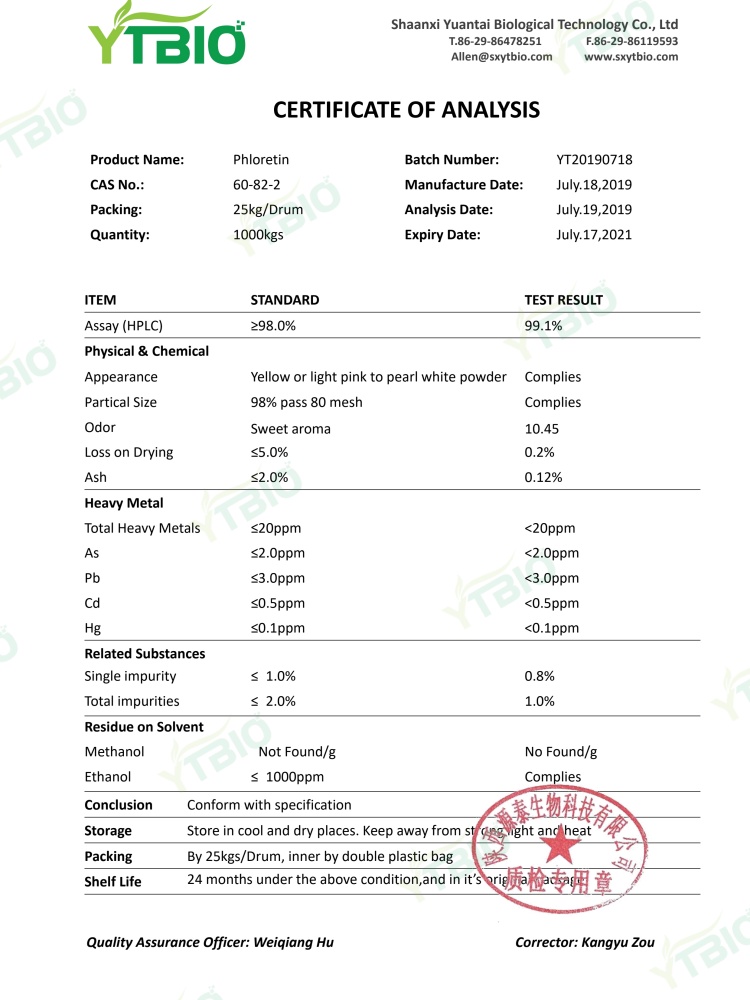
A: We can supply COA, MSDS, CAS certificate, product specifications, relevant certifications and customs clearance documents.
Q: What’s the shelf life?
A: The product shelf life is 24 months when stored in a cool, dry place.
Email: sales@sxytbio.com
WhatsApp/phone: +86 17782577059